
Oral Cancer Surgery and Consultation in Hyderabad
Consult a surgical oncologist in Hyderabad about a non-healing mouth ulcer, a white or red patch, or a diagnosed cancer of the tongue, cheek, gum, floor of mouth or lip. Dr. Sanjay Yadagiri explains the planned excision, any neck surgery and reconstruction, and the support you will need afterwards.
Quick answers
- Who performs it?
- Dr. Sanjay Yadagiri, Consultant in Surgical Oncology and Minimal Access Surgery, Hyderabad.
- When is it considered?
- A non-healing ulcer in the mouth lasting more than 3 weeks; A persistent white or red patch on the tongue, cheek or gum (leukoplakia, erythroplakia). Suitability is decided after examination and tests.
- Where are consultations?
- Banjara Hills clinic, Mon-Sat: 1:00 PM - 5:00 PM. Sunday closed.
- How do I book?
- Use the booking form or call +91 70324 76866.
What is Oral Cancer Surgery?
Oral cavity cancers are among the most common cancers in India, driven largely by tobacco and gutka use. Surgery is the cornerstone of curative treatment for most oral cancers, often combined with neck dissection (to remove lymph nodes that may be involved) and reconstruction (to rebuild the tongue, cheek or jaw). Dr. Yadagiri's surgical oncology training at Basavatarakam Indo American Cancer Hospital & Research Institute and a Single Speciality Cancer Hospital covers the full spectrum - from early T1 tongue lesions treated by wide excision, to composite resections requiring flap reconstruction in collaboration with plastic surgery. Every case is discussed in a head-and-neck tumour board, so chemo-radiation is sequenced correctly with surgery.
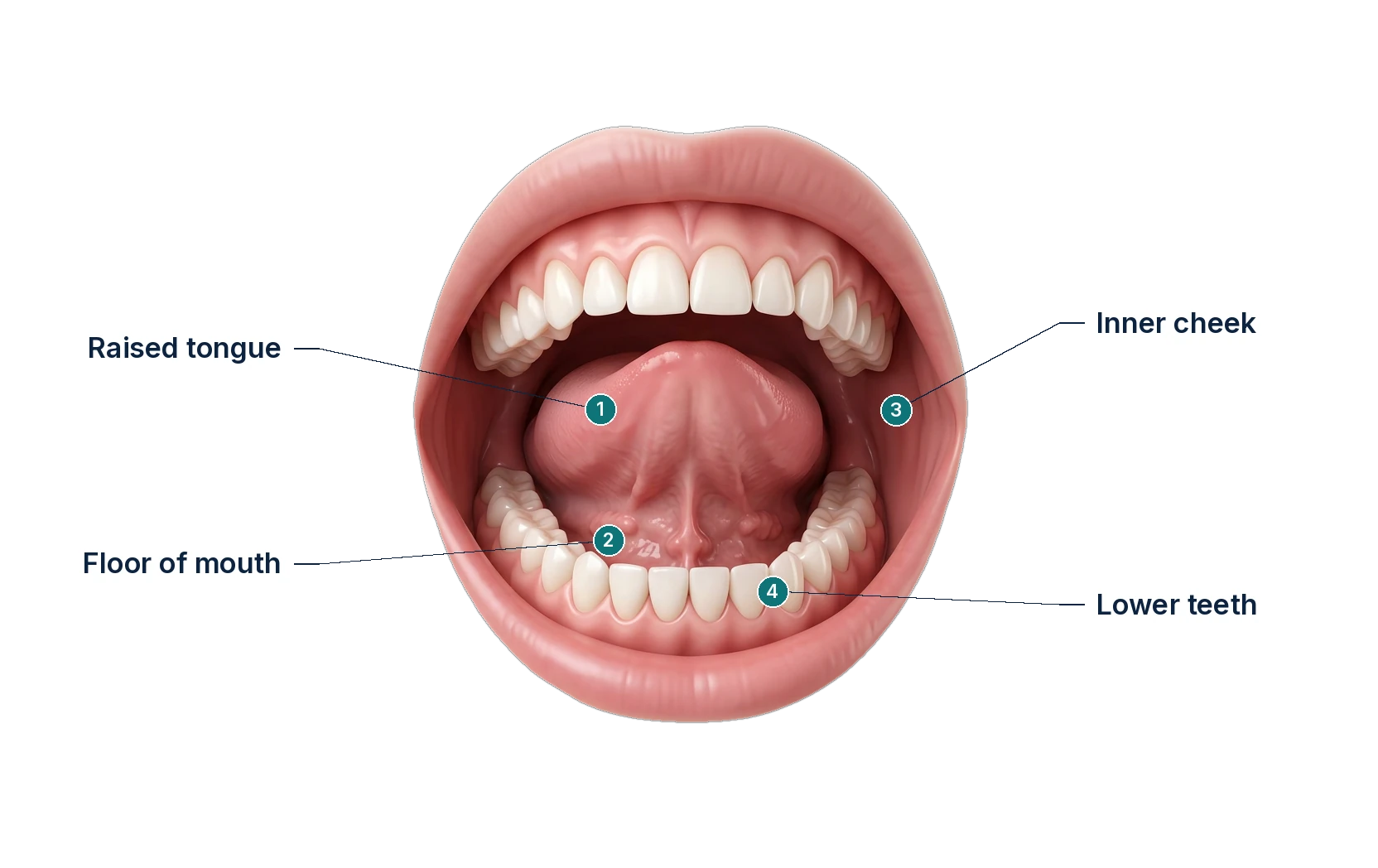
- Raised tongue
- Floor of mouth
- Inner cheek
- Lower teeth
The raised oral tongue exposes floor-of-mouth tissue beneath it, distinct from the lower teeth and lip. The inner cheek is a separate oral site; the site and extent of disease determine the surgical plan.
Mouth changes that should be checked
- A non-healing ulcer in the mouth lasting more than 3 weeks
- A persistent white or red patch on the tongue, cheek or gum (leukoplakia, erythroplakia)
- A lump, thickening or hard area inside the mouth
- Difficulty chewing, swallowing or moving the tongue
- A neck swelling or lymph node lump
- History of tobacco, gutka, areca nut or heavy alcohol use
Oral cancer treatment: excision with reconstruction, and support afterwards
Excision and reconstruction
- • Wide local excision with adequate margins (typically 1 cm clear)
- • Selective or modified radical neck dissection to address lymph nodes
- • Composite resection (mandibulectomy or maxillectomy) for bone-invading tumours
- • Reconstruction using local, regional or free flaps with plastic surgery
Recovery and follow-up support
- • Speech and swallowing therapy to help with talking and eating
- • Dietary support, including temporary tube feeding when needed
- • Dental review before and after treatment, especially if radiotherapy is planned
- • Regular follow-up visits and help to stop tobacco, gutka and areca nut
The extent of surgery and any need for radiotherapy depend on the tumour size, site, depth and the final pathology report. Plans are agreed with medical and radiation oncology colleagues and explained to you before treatment.
Recovery Timeline
- Day 0-2Surgery, monitored stay, tube feeding if needed
- Day 3-7Stepdown ward, speech and swallow assessment begins
- Week 2Discharge home; suture removal and wound check
- Week 4-6Adjuvant radiotherapy or chemo-radiation planning if indicated