
Cervical Cancer Surgery in Hyderabad
Cervical cancer treatment depends heavily on the stage. Surgery is one option, mainly for early-stage disease, and the right plan is agreed with a multidisciplinary team after careful staging.
Quick answers
- Who performs it?
- A gynaecologic oncologist has a specialist role in planning gynaecologic cancer treatment with the surgical team. Dr Sanjay Yadagiri is a Consultant in Surgical Oncology in Hyderabad and performs these operations within his surgical oncology practice. At consultation, discuss who will lead surgery and which specialists are needed for your case.
- When is it considered?
- Surgery may be considered for confirmed, selected early-stage cervical cancer after staging. An abnormal Pap or HPV screening result needs further assessment, not automatic cancer surgery. Some early tumours suit less extensive surgery; locally advanced disease is usually treated with chemoradiation.
- Where are consultations?
- Banjara Hills clinic, Mon-Sat: 1:00 PM - 5:00 PM. Sunday closed.
- How do I book?
- Use the booking form or call +91 70324 76866.
How is cervical cancer treated?
Cervical cancer starts in the cervix, the lower part of the uterus. Options include surgery, radiotherapy, chemoradiation and, for some advanced disease, targeted therapy or immunotherapy. A cone biopsy or fertility-sparing trachelectomy may suit selected early cancers. Selected small, low-risk early tumours may be treated with less extensive surgery, such as simple rather than radical hysterectomy. Radical hysterectomy with lymph node assessment remains an option for other early cancers. A gynaecologic oncologist helps plan the appropriate extent with the surgical team; locally advanced disease is usually treated with chemoradiation.
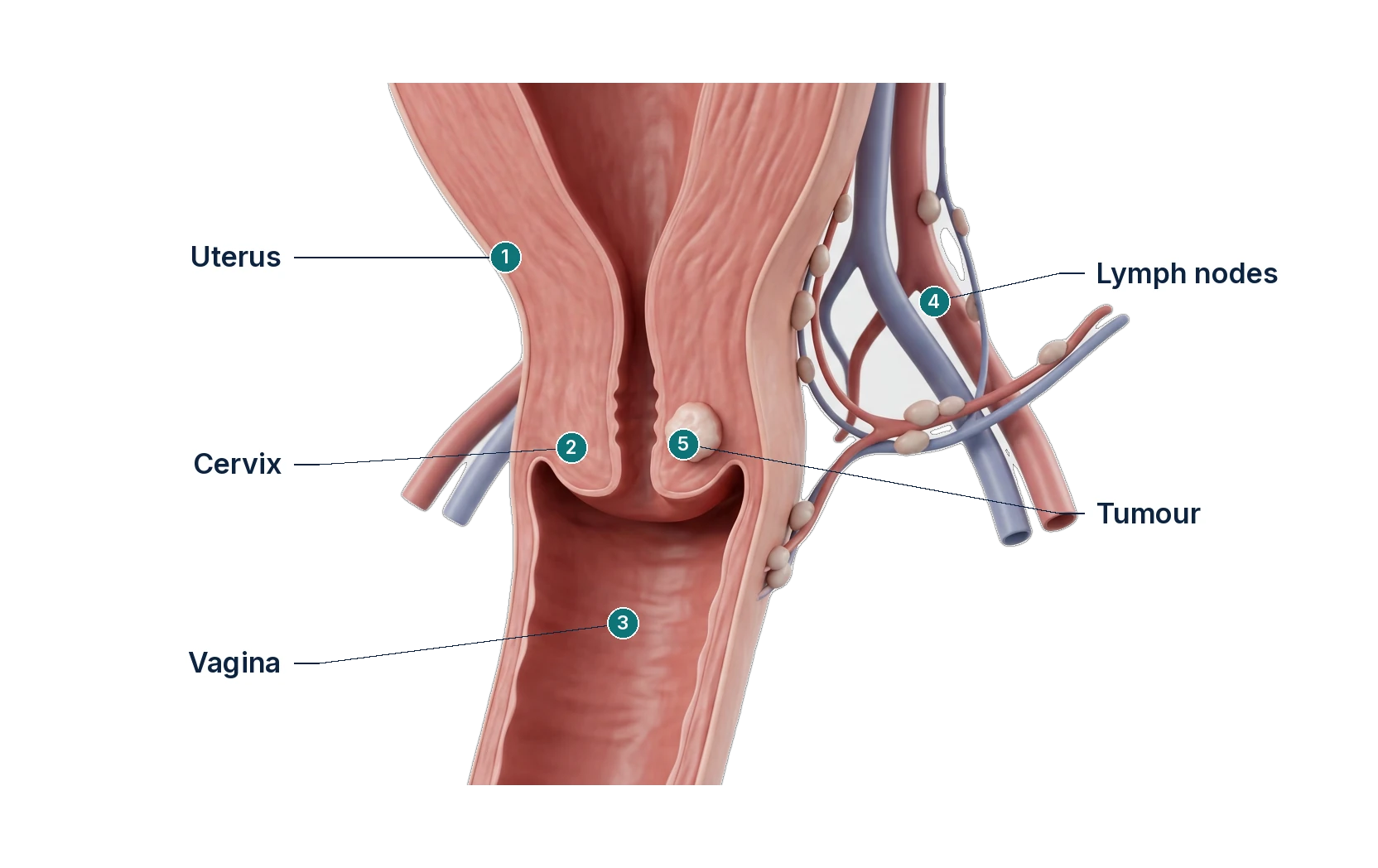
- Uterus
- Cervix
- Vagina
- Lymph nodes
- Tumour
The cervix is the lower end of the uterus, above the vagina. Only selected cancers suit surgery; stage and multidisciplinary assessment guide treatment.
Symptoms that should be checked
- Bleeding after sex, between periods or after menopause
- Unusual or blood-stained vaginal discharge
- Pelvic pain or pain during sex
Having one or more of these does not mean you have cancer. Most have other, more common causes, and only examination and tests can tell the difference. An abnormal cervical screening (Pap or HPV) result is not a symptom or a cancer diagnosis. It needs follow-up assessment, which may include colposcopy and biopsy; screening is not diagnostic.
Assessment and staging
- • Biopsy to confirm the diagnosis and cell type
- • Pelvic examination, often under anaesthesia when needed
- • MRI of the pelvis and further scans such as CT or PET-CT where needed to stage the disease
- • Review of the plan with gynaecologic, medical and radiation oncology colleagues
Surgical options
Operations used
- • Cone biopsy (conization) for some very early cancers
- • Radical trachelectomy for selected women wishing to preserve fertility
- • Simple hysterectomy with appropriate lymph node assessment for selected small, low-risk early tumours
- • Radical hysterectomy with pelvic lymph node removal
- • Sentinel lymph node biopsy in selected cases
Choosing the approach
- • Open radical hysterectomy is a standard approach for early-stage disease
- • Minimally invasive radical hysterectomy has been linked in research to higher recurrence in some groups, so it is not treated as equivalent
- • Surgery is not the main treatment for every stage
- • Approach and suitability are agreed with the multidisciplinary team
The approach recommended for you is discussed after clinical assessment, with scans and biopsy results reviewed where needed or available. Not every procedure requires a biopsy or scans beforehand.
Possible risks
- • Bleeding, infection and blood clots
- • Bladder or bowel function changes after radical surgery
- • Lymphoedema (leg swelling) after lymph node removal
- • Loss of fertility after hysterectomy
Other treatment options
- • Chemoradiation, the usual main treatment for locally advanced disease
- • Radiotherapy alone in some situations
- • Systemic treatment for advanced or recurrent cancer
Recovery
Recovery after radical pelvic surgery takes time and differs between people. Some women need further treatment, such as radiotherapy, depending on the final pathology report. Follow-up continues after treatment.
Frequently Asked Questions
Further reading
Independent patient and clinician information used as background for this page:
This page is general information, not medical advice. Your own treatment is discussed after assessment.